

See my new articles.
https://justiceforkennedy.substack.com/
Joe




 Posts
All Comments
Posts
All Comments
Yes, he's filed the paperwork and is running according to CNN. But he has not made a formal announcement he's running. A lot of media reports are highly critical of him for his anti-vaccine views.
See - Join RFK Jr.
Naturally, I'm very nervous about this.
And the big albatross around his neck are his views on vaccines. If he decides to run he has to make some statement about this. It's as important a factor as JFK's Catholic faith was an issue in 1960. He has to address this head on like JFK did when he went to Texas and talked to the Protestants in Houston in 1960.
Frankly, I would prefer for Joe Biden to be re-elected. Then RFK should run. It would be a wide open field as to who would be the new Democratic nominee.
From Keith Olbermann's Countdown podcast 1/9/23.
https://podcasts.apple.com/us/podcast/countdown-with-keith-olbermann/id1633301179?i=1000593088552
Insurrection.
No, not the one in Brazil, the one here still in full flower two years and three days after the Trump slobs were beaten back and this time the combatants will include, not the Proud Boys, but the Holman rule and the Linder letter.
It starts today when the Taliban 20 forces its combination Speaker of the House and hostage, Kevin McCarthy, to pass a House rules package dressed up in patriotic persiflage but actually designed merely to keep the insurrectionists from being prosecuted. The 2023 battle will be less mob rule and more Robert's rules of order but it will again take place at the Capitol. The House rules for the 118th Congress will establish something to be airily called The Subcommittee on the Weaponization of the Justice Department or something stupid like that when in fact it should be called The House Obstruction of Justice Subcommittee. This subcommittee will give itself the right to review "ongoing criminal investigations," which is a nice way of saying insurrectionists serving in the House like Gym Jordan and Matt Gaetz, and Perry, and Greene, and Gosar, to say nothing of Trump, or anybody else being investigated for their complicity in the January 6th coup attempt they will be able to use a congressional subcommittee to stop those investigations OF THEMSELVES.
Or, at least they think so.
Gaetz and Jordan, who are behind this, are trying to dress it up as some kind of protection for political free speech, and rights this and first amendment that when in fact it is an attempt by Jordan and Gaetz to keep Jordan and Gaetz OUT OF JAIL.
The problem with clever but lazy fanatics like Jordan and Gaetz is that they only read the headlines. They will hit the Department of Justice with demands for testimony, for evidence, of hearings, for witnesses and the Department of Justice will be able to tell Gaetz and Jordan TO SHOVE IT UP THEIR BASE.
A deputy assistant attorney general will write to Chairman Jordan or Chairman Gaetz a note, dry as toast, invoking the Linder letter and Attorney General Robert Jackson and presuming they get a grown up to read it aloud to them Gaetz and Jordan will be in for a big surprise. On January 27th, 2000, which is so long ago but the day I turned 41, Assistant Attorney General Robert Raven wrote to the House Chair on the Subcommittee on Rules, Congressman John Linder about this exact precise subject. No, not only can't Congress have, or see, or ask, or demand anything about ongoing criminal investigations but that that has been the policy of the United States government whether run by Democrats or Republicans since about 1900. Raven quoted Robert H Jackson, FDR's attorney general in 1941 citing something like forty years worth of precedence at that point in 1941. Jackson wrote that all investigative reports are confidential documents of the executive department of the government to aid in the duty laid upon the President by the Constitution to take care that the laws be faithfully executed and that congressional or public access to them would not be in the public interest. Raven also pointed out in 2000 what should be obvious to anybody not quite as stupid and slovenly as Gym Jordan and Matt Gaetz, he quoted one assistant attorney general for the Office of Legal Counsel, Charles J Cooper who had written, "providing a congressional committee with confidential information about active criminal investigations would place the congress in a position to exert pressure or attempt to influence the prosecution of criminal cases." The author of that quote, Charles J Cooper was the assistant attorney general under Ronald Reagan.
If a congressional committee is fully apprised of all details of an investigation as the investigation proceeds, wrote a deputy counsel to the president, Edward L Morgan, there is a substantial danger that congressional pressures will influence the course of the investigation. And that Mr. Morgan was deputy counsel to Richard Nixon.
It is an open and shut bright red line. Gaetz and Jordan and their Speaker hostage McCarthy are not the first yahoos who tried to save their own skins by pretending they have the right to review anything going on in the Department of Justice and given where the Republican Insurrectionist Party is going they will not be the last. However, DOJ will refuse. Completely. The House will then vote to find Merrick Garland or somebody else at DOJ in contempt and demand they be prosecuted for that contempt and that's when Jordan and Gaetz will realize that the only branch of law enforcement which can actually do that is the Department of Justice. Gaetz and Jordan will then be surprised as hell when the Department of Justice declines to prosecute the Department of Justice.
Presumably, the insurrectionists will be able to fundraise off this brouhaha, ha, ha, ha, and get the Republican umbrage machine to fire up and get Tucker "Jiminy Glick" Carlson to make some more vague threats of violence against somebody but the bottom line is they will not get to review the Special Counsel's case against Trump. Nor stop it. Nor review or stop the DOJ's case against Gaetz for sex trafficking, or anything else. So, when hands are rung later today about the House subcommittee on the deep state won't let Matt Gaetz Venmo payments for underage girls or the House Subcommittee to get Trump off the hook and blame it all on Pelosi just remember the Linder letter, and look forward to watching Gaetz and Jordan squirm.
The Linder letter's evil twin is called the Holman rule and I'm a little bit more worried about the Holman rule. What I want to hear at the appropriate moment is that the the Justice Department has not merely completed funding the Office of Special Counsel Jack Smith for the next two years but has already paid his salary, all other salaries, all foreseeable expenses and all unforeseeable expenses for everybody involved in the special counsel's office for the next two years. Because, of course, Kevin McCarthy, gave away the store to become Speaker of the House until, like Thursday of next week or whenever they over throw him, and part of the store he gave away is the attempt to reinstitute the Holman rule. The Holman rule is another vestige of the 19th century, like the Supreme Court clerical error declaring that corporations are people with which the Fascists can now try to strangle the 21st century.
The Holman rule is something somebody told Marjorie Taylor Greene about. And that idiot actually remembered it. Two words in consecutive order, nice job Marge! Marge treats this as if it were an incantation from a Harry Potter book rather than what it actually was. The Holman rule was congress trying to get a handle on out of control political patronage appointments to the civil service during the presidency of Ulysses S Grant. Essentially the House could vote to eliminate the salary of any federal employee one at a time if need be. Over the decades congress has not done much that justifies the cost of the oil with which to fry it in hell but give credit where credit is due here, we have not seen many corrupt political patronage appointments by President Grant or his lackeys recently. This one worked. Even the House recognized that this was kind of an old deal in 1895. They killed the Holman rule in 1895. It came back from the dead in 1911. It was the basis for a House bill unsuccessfully directed at 39 victims of the Red Scare in the 40's. It died again in 1983. And then it was resuscitated by the Republicans when they took the House in 2017. Congressman Ron DeSantis tried to use the Holman rule to punish his political enemies, and failed. Paul Gosar tried it, and failed. And most Republicans recoiled at what amounts to employment terrorism within the government, and a line item veto within the government, and most importantly revoking budget items after the budget had been approved. Even Republicans don't like the Holman rule. The Democrats killed it again when they took power in 2019. But what Marjorie trailer park Greene has been promising since the middle of last year was to get the Holman rule reinstated and use it to fire or to least cut the salary of anybody investigating or prosecuting Trump.
It is corruption to cover up sedition. It is probably not constitutional based on a ruling in that red scare case in the 40's because as the court then noted it is a bill of attainder and section 9, article 1 of the constitution prohibits bills of attainder. To translate, and God I remember this from 7th grade Social Studies, thank you Mrs. Rice, a bill of attainder is a legislature, NOT A COURT, declaring somebody guilty of something and punishing them without a trial. Legal in the England of the 1700's, NOT legal in the United States of any year, decade, or day.
So, if Greene gets the Fascists to pass a Holman rule action to cut Jack Smith's salary, or Merrick Garland's salary, or the salaries of everybody at the FBI it probably would not hold up in court. On the other hand it could create yet more red tape and time delay to hold up the prosecution of Trump.
So, the prophylactic solution to this anti-democracy, anti-constitutional, anti-law effort by Representative Cavewoman would be make sure everybody in special counsel Smith's office is already paid through 2024. Don't spend it all in one place. And then tell Marge to shove the Holman rule up her district.
So, the main attempt to protect Trump, and Gaetz, and Jordan, and Greene, and whoever placed the Jan 5th pipe bombs, and that I mention the pipe bomber right after I mention Greene is just a coincidence. The main attempt will fail. The secondary attempt may fail of its own weight, and if it doesn't it can be headed off at the pass. This leaves the Democrats and the administration more time to deal with what they should have precluded while they still had the majority the Republican terrorist plan to refuse to raise the debt ceiling, cause this country to default on its debts, and then, you know, crash the world economy.
I don't understand why Jefferson Morley has high hopes extreme Right-wing nutcases like Tucker Carlson or Rep. Thomas Massie will help. The Democrats were busy dealing with confirming Joe Biden won the 2020 presidential election and the Trump mob insurrection. They were literally attacked and had to flee the U.S. Capitol for their own safety. And the GOP senators and congressmen and women had to flee too. The mob even wanted to kill Trump's own Vice-President chanting "Hang Mike Pence!"
But, according to some the Democrats were just twiddling their thumbs and never were interested in a congressional oversight hearing on NARA's failure to properly declassify JFK assassination records.
So, now the GOP has control of the House of Representatives. And Morley posts this on Twitter:
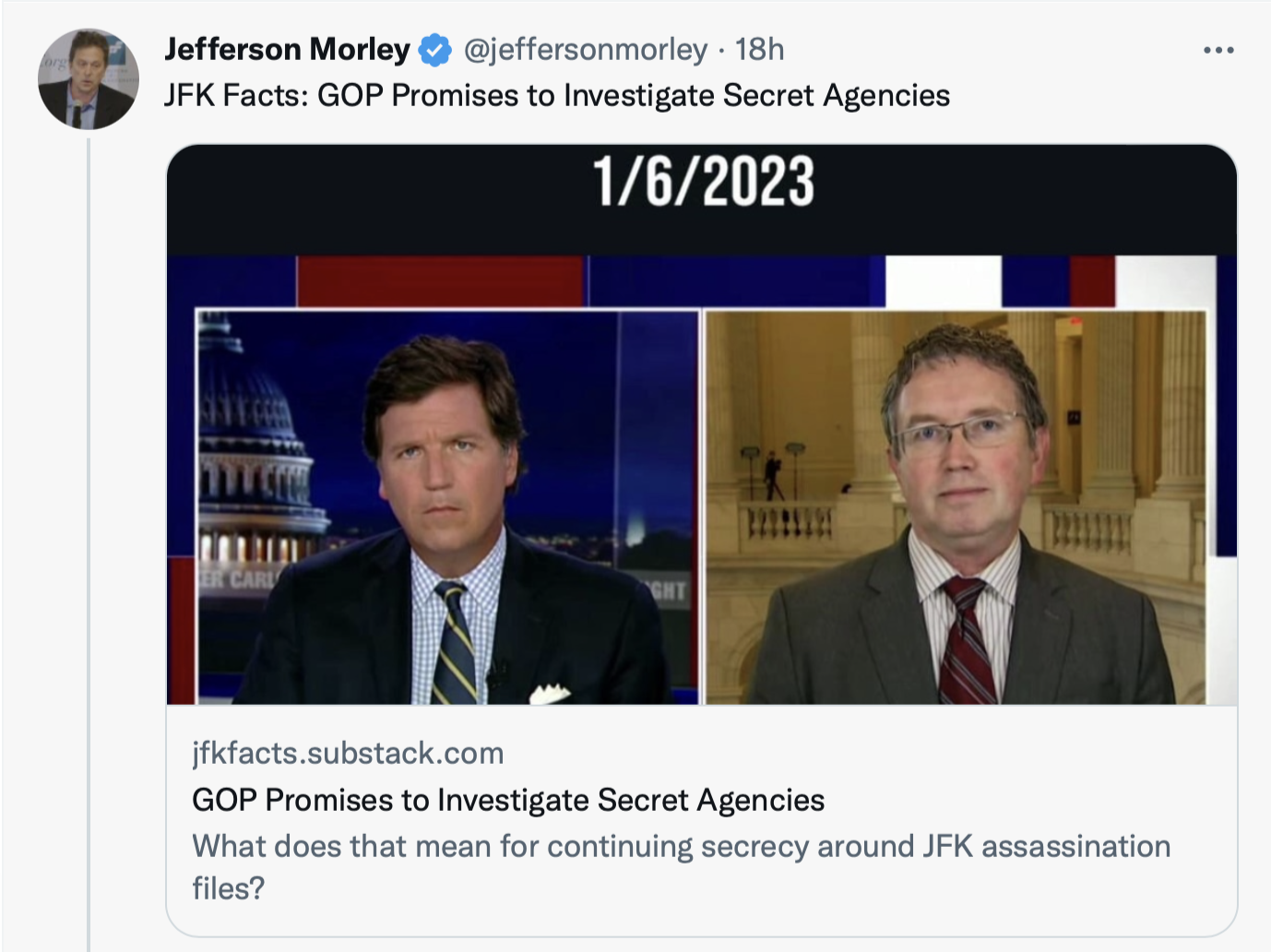
Rep. Thomas Massie is a scumbag.
Morley has forgotten a few of Massie's political stunt's so I'm here to remind you. You'll recall how he thought he could attack John Kerry and through him attack the science behind climate change because Kerry has a political science degree which to Massie wasn't a real science degree so therefore all the climate change stuff was nonsense. Do you remember that? Massie claimed, "somebody with a pseudo-science degree is pushing pseudo-science before our committee today."
But that's not the only dumb ass stunt Rep. Massie has pulled. You recall what he did about COVID? The senate approved a bill (96-0) to deal with the COVID crisis. And Congress was set to approve it via a simple parliamentary procedure known as "by unanimous consent," which requires only 2 members of the House to be present unless someone objects, which is exactly what Massie did. All of Congress had to come back and be physically present in the House chamber putting themselves and others at risk of COVID exposure to vote in person just to satisfy this stunt of Rep. Massie. EVERYBODY HATED HIM, including then President Trump for doing this.
That was not the only time Massie pulled the exact same stunt. He didn't want a $19 billion dollar aid bill to pass by a voice vote either. In May 2019 Massie objected to that bill designed to help states hurt by hurricanes, floods, and wildfires.
Massie doesn't give a shit that he endangered lives by demanding people have to be physically present to vote for the bills he cares about during a pandemic. Massie doesn't give a shit about delaying or cancelling help to his own country. For him it's all about grandstanding on an issue. He hates the parliamentary procedural votes that get things done. The GOP want to kill those in favor of everyone being physically present to vote. So, everything, every bill, every measure to move a bill, vote on a bill, vote on an amendment, even to vote to adjourn will be a shit show circus just like how Rep. McCarthy became the new Speaker. If you thought Rep. Matt Gaetz and Rep. Boebert were grandstanding during that, well, you ain't see nothing yet. Little shits like Massie, and Gaetz, and Boebert will hold the whole country hostage, each one thinking they're the star, the lead actor in their own warped version of "Mr. Smith Goes to Washington," when in reality it's just narcissistic bullshit.
But, forget all that. Now Massie and others of his ilk are in power in the House and Morley thinks they're going to do the right thing and declassify the JFK records? Morley has hopes idiots like Rep. Thomas Massie and Jim Jordan will reveal the unholy truth of who killed JFK?
Don't hold your breath.

CNN -
Two people who sold Ashley Biden's journal and other items to Project Veritas pleaded guilty in Manhattan federal court on Thursday.
Aimee Harris and Robert Kurlander pleaded guilty to stealing Biden's belongings and selling them to the conservative media group for $40,000, according to court documents.
In September 2020, Harris moved into a Delray Beach, Florida, home where the daughter of now-President Joe Biden had recently lived and temporarily stored some personal belongings. Harris solicited Kurlander's help to sell Biden's valuables to the highest bidder, according to the criminal information.
The pair attended a Donald Trump fundraiser on September 6, 2020, hoping to arrange a sale to the then-President's campaign.
According to the documents filed Thursday, Kurlander texted Harris after the event saying, "[Trump] campaign can't use it. They want it to go to the FBI. There is NO WAY [Trump] can use this. It has to be done a different way..."
Days later, they sent photos of some of Biden's belongings to Project Veritas. The organization paid for airfare, hotel, and a car service for the pair to transport the property from Florida to New York City, according to the court documents.
Kurlander acknowledged the crime in a text to Harris, saying that Project Veritas is in a "sketchy business," the court documents show.
"They are in a sketchy business and here they are taking what's literally a stolen diary and info . and trying to make a story that will ruin [Ashley Biden's] life and try and effect the election. [Ashley Biden] can easily be thinking all her stuff is there and not concerned about it. . we have to tread even more carefully and that stuff needs to be gone through by us and if anything worthwhile it needs to be turned over and MUST be out of that house," the text message said.
Harris took more of Biden's belongings from the house after their New York meeting at the request of Project Veritas, according to the court documents. A Project Veritas employee then flew down to Florida to get the additional items and shipped them back to New York, the court documents say.
No one from Project Veritas has been publicly charged in connection to the alleged scheme.
Harris and Kurlander pleaded guilty to one count of conspiracy to commit interstate transportation of stolen property, which carries a maximum sentence of 5 years in prison, according to sentencing guidelines, but a judge will ultimately decide their sentence. They are not being held, pending their sentencing later this year.
Harris "accepted responsibility for what happened and she's looking forward to moving on with her life," her attorney Sanford Talkin told CNN.
CNN reached out to an attorney for Kurlander but did not immediately hear back.
In a statement released Thursday about the guilty pleas, Project Veritas said their employees' news gathering was "ethical and legal," adding: "A journalist's lawful receipt of material later alleged to be stolen is routine, commonplace, and protected by the First Amendment."
CNN has reached out to representatives for Biden for comment


